
Good World News

A+ A A-

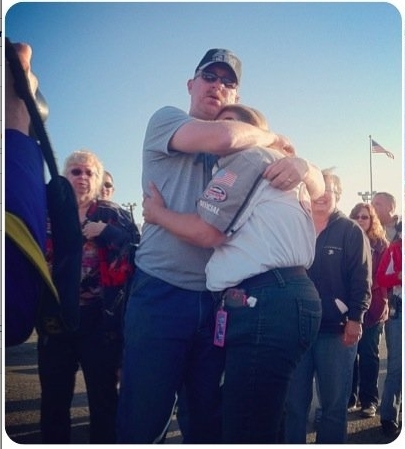
Steve Barrett ran a stock race car for years until he wrecked it in April 2012.  In June of last year, he was ordered to deploy to Afghanistan for 10 months.  Steve promised himself that he would rebuild his favorite stock car which he knew would be a huge project when he came home. 

What Steve didn't know was that while he was gone, his family and friends were secretly rebuilding a new super stock race car for him!  When he returned last month from Afghanistan, his friends and family had a ceremony for him where they revealed their big secret. 


Enjoy your new Stock Car Steve!!


Have a great day, and let the good news be yours :-)
 
Jeremy
Published in Lifestyle

Have you ever felt that peaceful and calm sensation when there is a nice warm campfire or a collection of candles in a quiet house?  Well the Robbins family wanted to experience that feeling each night in their Orange County, California home!

Stacey Robbins explained - "The way people feel when they leave a camping experience is like, 'Ahhh.' It's like they're exhaling a little more deeply and they're sleeping better and they feel more refreshed. And I thought, 'How do I bring that into the conveniences of our home?'"

Stacey and her husband Rock decided that the entire family would turn off all electricity at sunset every night for a month.  No computers, no phones, no lights!  The Robbins family enjoyed it so much, they extended their one month trial to four! 

Their sons, Seth and Caleb, really enjoy playing piano and violin by the candles.  The Robbins have become closer and have noticed more positivity during their candlelit hours!  Plus it saves on electricity :)

And that's what's good,
Jon

Published in Lifestyle

18 year old Samantha Manns is remembering her beautiful great-grandmother, Virginia ("Jinjey"), in the best way possible - with good deeds.  Samantha's great-grandmother, who had a profound effect on her life, recently passed at the age of 89.

“Some of her last words were, ‘I don’t want anybody to be upset.’ And I was really upset for a few days,” Samantha stated. “Then I thought, maybe I can’t be happy right now, but I can do things to make other people happy.”

It all started at the McDonald's drive-thru where she paid for the person behind her in line.  Samantha said she looked in her rear-view mirror and saw that the customer was crying tears of joy.  “It made me feel pretty good.”, Samantha said.

She went on to creating a Facebook page called 89 Acts where she continues to list her good deeds.  As the site grew in popularity, she created 89 Acts packets which detail good deeds that anyone could do.

“It’s crazy how many people have asked me for the packets,” Samantha said.

And that's what's good,
Jon

Published in Lifestyle

Noah Harrison, 19, has always made all of his gifts to his mother by hand.  Every birthday, every Christmas, and every holiday.  This year his gift was the gift of life.

Two years ago, Noah's mother, Erica Johnson was diagnosed with kidney failure.  She has suffered from years of chronic high blood pressure. 

“I am pretty sure this year’s gift will top them all,” Noah stated. “And what makes it even more special is that she didn’t even ask me. It’s something I really wanted to give her. Anything I can do to help my mom. She really needs this transplant. I want to be there for her like she has been for me all these years.”

“It has been a very humbling experience for me,” Erica emotionally stated. “As a mom, we are supposed to take care of our children and look after them. Here they are, helping me. They all made selfless decisions to donate."

“I have worked to protect my children from harm and pain and for one of my own children [Noah is her youngest of three children] to go through this for me … he is just such an awesome young man,” Erica tearfully said. “I always said I never had to raise children who would become doctors or lawyers, but they had to be decent human beings. “I feel I have accomplished that.”


Peace & Love,
Jon
The Good World News

Published in Health

Dog saves child from runaway vehicle

Geo, a seven month old German Shepherd-Collie mix is now a famous hero after saving a young boy's life. 

Carly Riley and her three sons Charlie, Ben, and Josh from Clacton-on-Sea, Essex were out for a walk with their puppy, Geo, when an out of control car started speeding their way.  The erratic driver jumped the curb and was heading straight for 10 year old Charlie.

Geo sprang into action and pushed Charlie out of the way and took the hit himself.  The impact launched Geo into the street where the crazy driver hit him again and drove off without stopping.

"Geo must have sensed it [the truck] as he leapt on Charlie and took him out the way. It could have wiped us all out." Riley said on DogHeirs.com "If it wasn't for Geo I am 100 percent sure it would've been Charlie".

Geo, the hero, was in critical condition.  He had a broken spine, broken leg, and many internal injuries, but miraculously the veterinarians say he will make a full recovery.  This full recovery will cost $16,000, but the family has no question about trying to pay the bills to save their dog, no matter how hard it may be to pay it. 

“Geo and the boys have a fantastic relationship,” Riley said. “They always play with each other, whether it be football or Geo’s favorite, jumping on our trampoline with them. He is family."

The Riley family has set up a facebook page to tell the story, share pictures, and take donations.

This wonderful canine is definitely a hero.  He has performed a selfless act that will be forever remembered!


Peace & Love,

Jon

- The Good World News


Published in Random Good News

Parents each donate a lung to save their son

Marius Schneider, a 12 year old in Germany, is now on a steady path to recovery thanks to his loving parents.  Marius was suffering from cystic fibrosis, a genetic disease which causes thick mucus to build up in the lungs.  His family was desperately waiting on a lung donor, but time was running out.  Marius was breathing through a ventilator in order to survive. 


Even though times seemed rough, Schneider was in luck.  He has parents that were willing to do anything to get him healthy and they had the help of Germany's top transplant surgeon, Professor Dr Axel Haverich.  Marius' father, Lars, stated, "We were desperately waiting for an organ, waiting for a call every day".  When a donor could not be found, Marius' parents decided that they would each donate one of their lungs to save their child.  Dr Gregor Warnecke, the doctor in charge of Marius' care said "The transplant was his last chance.  The hospital would not have operated on his parents if it had not been an absolute necessity".

The surgeons at Hannover Medical University operated on all three of them at the same time and the procedure was successful.  "Marius was already somewhere between heaven and earth when we operated", Professor Dr Axel Haverich stated. "He was living in a state of almost perpetual anesthesia.  But he is a real fighter. We had a team of 40 and he came through."

Marius was released from the hospital after 155 days and he can now lead a healthier life without breathing assistance thanks to his loving parents!


Peace & Love,

Jon

- The Good World News

Published in Health

They call themselves "Team Maddy".  The team consists of Rick van Beek and his daughter Maddy who has cerebral palsy.  Maddy's cerebral palsy makes her unable to talk, see or walk.  In a blog post, Rick explains how he used to smoke two packs of cigarettes and chew a tin of tobacco every day.  He had been smoking since the age of 12.  But he stopped all of his unhealthy habits because of his daughter.  She helped him and he helped her.

Rick's life turned around when he saw his daughter being pushed along through the Grand Rapids Marathon.  "To see her being so happy and enjoying every bump in the road was more than I could handle, my emotions took over.", Rick said.  From that point on, he quick smoking and starting doing triathlons with his daughter.


Rick told TODAY, “It was that day that I realized, Madison is not a burden ... she is a blessing that has changed our lives and so many other people’s.  Before Madison showed me the way to a healthy lifestyle, I guess you can say I was running away from it.”

Rick van Beek pulls Maddy in a kayak during the swimming portions and he rides with her attached to a cart during the biking sections.  The father daughter duo has participated in over 75 racing events.   This is one father daughter team that continues to inspire many!


Peace & Love,

Jon

- The Good World News

Published in Sports

'Fun Grandma' earns her title

Good News found on CNN.com:

(CNN) -- My grandchildren and I made history this summer. It was our personal history; our family history. We made memories we'll be able to relive and pass on to others.

The adventures began when I asked each of my three oldest grandchildren to pick a place he or she wanted to visit and do research on the fun activities the child and I could do there -- just the two of us -- for a week.

No amusement parks, no fancy hotels; my finances were limited because of a recent forced retirement, so we would be camping, as well as finding inexpensive or free things to do. The location had to be east of the Mississippi and require no more than one overnight stop to get there by car from our starting point, their home near Nashville, Tennessee.

It turned out only Rosa, 14, had enough decision-making experience to pick a spot (New Orleans -- only slightly west of Mississippi), so I talked the possibilities over with the others -- Savannah, 11, and Camron, 12 -- until we decided on itineraries for their trips.

Sheila Evans and grandchildren Camron, left, and Rosa, right, dig into ice cream in Cincinnati, Ohio, where Evans picked Camron up for his week\'s vacation with her in Michigan.
Sheila Evans and grandchildren Camron, left, and Rosa, right, dig into ice cream in Cincinnati, Ohio, where Evans picked Camron up for his week's vacation with her in Michigan.

Savannah chose to go to Savannah, Georgia, and Hilton Head Island, South Carolina, doing lots of swimming and sightseeing. We included stops at her favorite aunt and uncle's home in Atlanta along the way.

Camron did not feel strongly about a location, so he joined me at home in Williamston, Michigan, and helped me with some cat-sitting duties. Still, our time together included camping on Lake Michigan, climbing a sand dune and discovering or rediscovering lots of near and distant relatives.

Rosa was decisive about seeing New Orleans, and her research resulted in a whole list of places to go and things to see, all of them affordable. We covered everything on her list, plus more.

I had some concern that traveling with young teens or preteens might be tricky. Would they talk to me? Would they be bored? Would we enjoy the same activities?

Their excitement dispelled any misgivings.

Each one was happy going just about anywhere and eagerly anticipated their own "grandma time." The chance to be special pals for several days overshadowed the importance of the actual destination on both sides, and I never heard one mention of being bored.

So consider a trip with your young relatives. Make memories. Here are some strategies that helped make these summer trips historical -- and smooth -- for us:

Stock up. Stopping at the grocery store was always among our first orders of business. Each grandchild got to select food he or she especially liked, keeping in mind that we would be cooking on my small electric hotplate. They were all very considerate of my needs as a vegan and tended to choose food we both could eat. We also splurged on simple treats that would withstand the rigors of long car rides and camping.

A board and goggles from Grandma were a hit with Savannah on Hilton Head Island, South Carolina.

Be curious. The grandchildren controlled the radio, but sometimes we turned it off and just talked to each other. Camron decided to ask me questions: "What is the most dangerous thing you've ever done?" Or, "Where would you go if you could go anywhere in the world?" After I answered, often with a story about his father as a child or my adventures living in Jamaica, I would turn the question on him, and he would regale me with his own dreams and adventures.

Join in. Memories were made when I actually got in the water, climbed the hill, let the birds land on me and generally participated first-hand in what my grandchildren were enjoying. Watching them play or taking pictures was nice, but something great happened when we were able to splash, race and float together.

Stay loose. Simple things were often the most memorable things. A ride on the trolley car, meeting new relatives, preparing a meal together and hearing one another's personal stories were the things that the kids talked about long after the trip was over.

The limits on spending didn't deter them, either.

Some of our best times were spent having dessert in an all-night coffee shop, holding a live chicken for the first time, finding an airport with the same name as Savannah, admiring the architecture in the French Quarter, naming rocks discovered on the beach at Lake Michigan and watching Grandma go nuts when the directions did not get us to where we wanted to go.

Rest. Down time was some of the best time. After a day of being on the go, a trip to the grocery store, a few minutes watching TV together, a swim in the pool or some other quiet activity were often ideal times to relive the fun of the day, plan the next outing or find that one more thing we had in common. Rosa cooking me dinner at the campsite, using shrimp we had bought in the French Quarter, was one of those low-key evenings that proved to be a high point.

Don't overplan. Planning for each trip was essential, but some of the best opportunities to make history together came when we least expected them. Case in point: We ran into my sister at the local library and discovered that her grandson was visiting. Our two grandsons ended up spending the night together camping on my balcony and having their own adventures.

Are you a window flier or an aisle seater?

Share decision-making. Each grandchild was at a different level of maturity regarding making choices, but as their week progressed, I saw each one grow in their ability to come up with wonderful ideas, to be considerate of the needs of both of us and to choose among good options.

Stay connected to home. It was a surprise to me that at 11 and 12, Savannah and Camron each had a real adjustment to make being away from home, without parents or siblings to look to. Vannah brought along a framed picture of her parents, which helped her feel more secure. My cell phone served as a lifeline for both children, as well as for Mommy, who was suffering a little separation anxiety herself. Each day the children grew in their independence, and the phone calls got fewer and shorter as our time together stretched on.

Keep a record. To continue sharing our stories after the week was over, I purchased inexpensive thumb drives for each grandchild and saved all the pictures from their trip on their own drive. This way, we both would have copies of all the pictures. The day after we returned home, Rosa posted all of her 497 pictures on her Facebook page.

Listen. One of the experience's unexpected blessings came when I was able to stay for a few days with the whole family after each trip. This gave me a chance to hear the stories of our trips from my grandchildren's perspectives.

The extra bonus: I am now the "fun grandma."


Evans, Sheila.  "'Fun Grandma' earns her title". CNN. 30 August 2012. Web.

View original good news article at cnn.com:

http://www.cnn.com/2012/08/30/travel/grandmother-traveling-with-kids/index.html


Published in Random Good News

The Luck family - Another NFL Dynasty

WHEELING, W.Va. -- On the last Interstate 70 stop before West Virginia mountains give way to Ohio green, a tall man with perfectly swept hair works the White Palace ballroom. He is charming, almost presidential, which is good because this is a heavy-hitter crowd. The governor of the great state of West Virginia is here, as well as a roomful of bankers, lawyers and schmoozers. A prayer is said before their supper of sautéed chicken and green beans, and cocktails are poured in plastic cups.

They have gathered on this late-April night to see Oliver Luck, a man whose bio in the Wheeling Chamber of Commerce dinner program fills an entire single-spaced page. Luck is all over the West Virginia map these days, dining with Boy Scouts and rubbing elbows with Rotarians, because this is what the athletic director for West Virginia University does in the springtime.

 He does not rattle off his résumé, which sounds as if it could be a "world's most interesting man" script. Former NFL quarterback. Rhodes Scholar finalist. World traveler. Former president and CEO of NFL Europe. Ran a Major League Soccer team that won a couple of championships. Oh, and he has a law degree, which he picked up taking night classes while in the NFL. But Luck taught his kids to be humble, which is why you'll hear very little about any of this tonight. 

He steps to the center of the stage to give his speech about West Virginia athletics, and breaks code a bit, probably to break the ice.

"You know," Luck says as he grabs the microphone, "there's a whole page here dedicated to my bio. And if you go on Wikipedia right now, what you'll see under my name is simply, 'Andrew's dad.'"

The crowd laughs. 

"That's who I've become, and I'm very proud of it." 

On Thursday night in New York City, in one of the most anticlimactic starts to an NFL draft, the Indianapolis Coltswill select Andrew Luck as the No. 1 pick. And the professional career of the most hyped quarterback sincePeyton Manning will begin. What can you say about this 22-year-old? That Oliver Luck's oldest boy has seemingly zero flaws, that he is so polished he would've been No. 1 in the 2011 draft, that he is so good his arrival has jolted the quarterback landscape in three NFL cities?

Oliver can wax on about the Big 12, coal mining and West Virginia's economy, but generally, he holds off on saying much about his son. Hyperbole is not the Lucks' thing. He will recognize that this is a big deal. The Lucks are about to become just the seventh known father-son quarterback combination in the NFL, following a distinguished group that includes the Manning family. For years, analysts have broken down the genetic success of Archie, Peyton and Eli, comparing arms, speed and size. But most of the time, a father's influence goes way deeper than any kind of metrics.

Oliver Luck's influence is somewhat intangible. It's there in the huddle where, no matter the situation, Andrew is seemingly unflappable. It's the reason Oliver's son, an All-American at Stanford who is about to get his degree in architectural design, is so well-prepared and grounded. 

The elder Luck, of course, wants nothing to do with any chip-off-the-old-block conversations. Talk to his mother, Luck says, because Kathy plays just as big of a role in the making of Andrew Luck.

A few days after the grip-and-grin in Wheeling, as Oliver is driving to Charleston, W.Va., he says he's talked to Kathy -- and sorry, she has politely declined to be interviewed. She likes being in the background.

"Have you ever heard of the book 'Freakonomics'?" Oliver says. "So there's these two economics professors, and they're really interesting guys, and they wrote these books. And it's really all about sort of false thinking. They try to go in and look at a number of different phenomenon. Does A really cause B? You know, causation. 

"They wrote a chapter in the book about major league baseball players. What characteristics at what age would be an indicator that the kid is really going to make it to the major leagues? Is it when they were born? … Is it size?"

At the end of the chapter, he says, the authors tell the reader that none of these factors comes close to the only important one, which is having a father who also played major league baseball. So maybe it's just in the genes.

Luck is a voracious reader, by the way. He has no problem talking about that. Oliver is currently tackling a book on the history of Spain. He's read it before. In the hundreds of interviews Andrew has done since arriving at Stanford, he is occasionally asked about his favorite thing to do besides football. His answer is usually the same.

Reading, he says. 

LuckAP Photo/Paul SakumaThe Indianapolis Colts say they will select Stanford quarterback Andrew Luck as the No. 1 pick of the 2012 NFL draft.

The origins of Andrew

Andrew Austen Luck was born Sept. 12, 1989, in Washington D.C., the first of many addresses for a son born to two lawyers. There was a "Monday Night Football" game on the night father, mother and soon-to-be son were in the hospital, and Oliver recalls at some point looking up to catch the score. He says he's fairly certain that former West Virginia quarterback Jeff Hostetler was playing that night, but you'd have to check to make sure. Of course, he's right. 

The couple went on to have four kids -- their daughter, Mary Ellen, plays volleyball for Stanford -- so it's fuzzy as to who first put a football in Andrew's hands. It didn't really matter. 

"My wife and I didn't raise our kids to be anything except what each one ultimately wants to do," Oliver says. "I can't imagine raising a child with a goal of that child being a baseball player or a lawyer or whatever. Odds are, they'll be something else. In this world, there are a lot of opportunities." 

Oliver Luck did not possess the physical gifts of his 6-foot-4, 234-pound son. He was a tall and skinny quarterback from St. Ignatius High School in Cleveland who went to West Virginia because he fell in love with the school and community. The scouting report on Luck went something like this: smart, talented, good arm, not-so-good runner. But tough. If Luck threw an interception -- he didn't throw many -- he didn't float backward and get out of the way. He went after the guy running with the ball. 

His first two years with the Mountaineers yielded back-to-back losing seasons. It wasn't for lack of effort. Luck stayed in Morgantown every summer, training with his teammates while working eight hours a day doing odd jobs at a coal mine.

In 1980, the Mountaineers' fortunes changed when Don Nehlen took over as head coach. Nehlen was not overwhelmed with confidence when he met Ollie Luck.

"When I first looked at him," Nehlen says, "he had that big Adam's apple and that big nose and skinny shoulders. And I'm saying, 'Oh my gosh.' I told my wife, 'Don't unpack.' 

"But Ollie had it all. He gave us the ability to be a pretty good football team. Believe it or not, we won six games that first year and nine the second. If we don't have Oliver Luck, we don't win. He's one of those guys the kids really rally around. He made the other 10 better than they really were. And all the great quarterbacks do that." 

Oliver Luck's draft day was far less heralded than his son's. He was selected in the second round by the Houston Oilers, after Art Schlichter and Jim McMahon. He did not play his rookie year, then was inserted as a starter during a disastrous 2-14 campaign in 1983. Luck threw eight touchdowns and 13 interceptions that year. And the following season, the Oilers signed Warren Moon from the Canadian Football League.

Luck spent the better part of the next three seasons carrying a clipboard behind a future Hall of Famer. But Luck was still competitive while helping Moon in whatever way he could. 

"He always had a smile on his face," Moon says. "He was one of the smarter guys that I've been around at quarterback. He was so well-rounded. He knew different languages. Some guys come off as smug because they're intelligent and think they're more intelligent than everybody else. But he was never that way. The guy had such an easygoing personality that you would never know that side of him unless you really got into an in-depth conversation with him."

After his fifth season, Luck sized up his situation, realized he wasn't going to play much, and decided to call it quits. He was 26 years old. It was different back then, he says. The desire to hang on wasn't necessarily there. Luck could walk into a law firm and make nearly as much as he did as an NFL backup.

Most important, he could still walk. Asked if he regrets leaving the game so early, he says "no" three times in rapid-fire succession. His kids wouldn't get the chance to see him play, but that didn't matter. Luck had a lot to do. 

Indianapolis Colts FansIcon SMIColts fans who struggled through a 2-14 season are looking forward to Luck.

The cultural influence

There was the failed bid for Congress in 1990, when Andrew was just a baby, and a job in Germany as general manager of the Frankfurt Galaxy in the fledgling World League of American Football. Luck dabbled in just about everything, and he spent more than a decade overseas running football teams and eventually becoming president and CEO of NFL Europe.

The jobs were nice, but the Lucks loved the opportunity to pile their kids in a car and take them from Frankfurt to the Eiffel Tower in five hours. They'd ride on the autobahn and be fluent in German, English and whatever else they wanted.

"There's a whole body of literature on the culture of kids," Luck says, "kids who grew up outside of their home culture. I don't want to necessarily summarize all the literature, but ultimately, I think [those] kids are a little bit more tolerant because they can see there are different ways of living.

"I think they're a little more inquisitive. And they get exposure to some things that make them think a little more about different places, different cultures and different languages." 

The exposure has helped Andrew Luck in many ways. For starters, he played soccer as a boy, which no doubt helped his footwork. He saw beautiful stadiums and wanted to become an architect. When the world became smaller for young Andrew, nothing seemed too big.

"He walked on campus different," says David Shaw, his college coach at Stanford. "A lot of times, even our best players and our best students still have a transitional period. And there was never a transitional period for Andrew.

 "Being as well-traveled as he is, he doesn't just have his immediate surroundings as his only context to life. He doesn't approach the world with blinders on. He doesn't get fazed. He's seen a lot, and he's been through a lot."


Oliver LuckGeorge Gojkovich/Getty ImagesOliver Luck, playing for West Virginia in 1981.


Learning the game

Oliver Luck jokes that his long list of titles just means that he was never able to hold on to a job for very long. The family moved back to the U.S. in 2001, when he was named CEO of the Houston Sports Authority. It was a chance to get back to Texas, and an opportunity for his son to test his chops in the biggest football state in the country.

Much like his dad, young Andrew did not wow anyone at first sight. "He was a 14-year-old kid," says Stratford High coach Eliot Allen. "He wasn't the guy you see now. But I think you saw then the kind of person he was." 

The younger Luck was smart and polite and made 10 guys look better. His father did not show up at practice, Allen says. He didn't talk X's and O's with his son. He wanted him to learn and grow from his coaches.

So Andrew did, and threw for 7,139 yards and 53 touchdowns at Stratford. He was co-valedictorian for the Class of '08. Oliver taught Andrew about leadership and being mentally strong, Allen says.

"And don't forget his mother," Allen says. "She's pretty influential, too. We'll never hear about her because she's behind the scenes. But she has her law degree."

Kathy Luck, according to John Hardesty, one of Oliver's close friends, is a quiet, strong and smart woman. She holds the family together. When Oliver took the West Virginia athletic director job in 2010, he was living in a small condo in Morgantown while his family finished business in Houston. He'd catch red-eye flights to Houston and Stanford to watch Andrew play. 

They made sacrifices but have rarely had regrets. One Saturday last year, when West Virginia had a late game and Andrew was playing on the West Coast, Oliver sat in his office, in the dark, trying to find the game on the Internet.

 "Here's a guy, his son's the Heisman Trophy candidate, and he and I are watching the game, 11:30 at night on the computer in his office," says John Garcia, an old college teammate of Oliver's. "Here we are watching it in the dark because he can't get to the game.

"People don't know the commitment that he's made. I think that says something about him."

LuckBill McCay/Getty ImagesArchie Manning, Andrew Luck and Oliver Luck at the 75th annual Maxwell Football Club awards dinner last month in Atlantic City, N.J.

The expectations

There is significance to Oliver Luck's stop in Wheeling the week before the draft. Because it is right off the interstate, on the way to Indianapolis, he'll be driving by it a lot. He tells the crowd that he plans to buzz by here during the fall for the next 15 years. He believes his kid could have that kind of staying power.

Colts owner Jim Irsay must believe it, too. 

Andrew will shrug and say that it does not put any extra pressure on him, and Pops will reaffirm that. Every player on an NFL roster is under pressure, Oliver says. He can probably substantiate that with the help of some book he's read.

So no, Oliver Luck is not worried about his son living up to these rare expectations. He will celebrate with him in New York, then go back to work in West Virginia. He knows Andrew will be fine, and that his football dream will last longer than his dad's. In the offseason, in sort of a full circle moment, Warren Moon worked with Andrew.

"The kid doesn't have any weaknesses," Moon said.

It reminded Moon, in many ways, of Oliver.


Merrill, Elizabeth. "Andrew Luck -- like father, like son". ESPN. 26 April 2012. Web. 

View original article at ESPN.com:

http://espn.go.com/nfl/draft2012/story/_/id/7854614/2012-nfl-draft-andrew-luck-gained-father-oliver-luck

Published in Sports
Good World News © 2013